Circling Back to Show Your Work!

Well, we’ve come full circle and have returned to exploring the importance of showing your work.  To me this emphasis on documenting one’s process has two main benefits.  For one, it keeps viewers engaged and invested in a creator’s work, as they are essentially teased with progress until the completion of the final product.  However, it also democratizes the creation process.  Communicating and sharing how you complete projects may inspire others to try their hand at it this work.  As such creativity may further more creativity.

From a design standpoint, Kleon uses visuals to break up the text in order to keep readers engaged.  Viewers (especially on e-screens) get tired of looking at blocks of text, so intermingling visually appealing items will help prevent fatigue.  In addition, these images often complement the points Kleon makes in each section.  For instance, there’s a great visual in the 2nd chapter of a swirling scribble with the phrase “Process is Messy,” labeled on it.  This not only makes a statement about accepting messiness, but demonstrates it with a symbolically messy design.  Including these sorts of depictions will help drive home his main messages while also reaching readers who are more visually-minded learners.  Furthermore, Kleon also has pull-out quotes that are more visually orientated to emphasize larger points.  Many of these have asymmetric backgrounds that hearken back to the theme of accepting messiness as a part of the creative process.  Ultimately all of these uses demonstrate how Kleo successfully utilizes design to compliment his work.

Dead Ripley

I’m a huge film enthusiast, so I loved the assignment idea of messing with central plot points of movies. What if major events had never happened?  How would this impact the rest of the movie?  I find such questions inherently fascinating, so I had to try my hand at these alterations.  As such, I began combing through my favorite movies, eventually settling on examining Aliens.  I’ve always loved this film.  In fact, it is one of the only movies where I truly think the sequel surpassed the original.  But what if Ripley had never been rescued?  What if she was dead when her pod was discovered?  The rest of the movie would simply never have happened.  So I grabbed a screenshot of Ripley enclosed in her pod, and added an altered version of the dialogue following her discovery.  The result is below.

dead-ripley

Design Reflection

I really appreciated how the Stranger Things article discussed the typographer Ed Benguist.  I was incredibly impressed that he was responsible for the logo for Planet of the Apes, in addition to major logos for The New York Times and Sports Illustrated.  Its amazing how many specialized individuals are connected to major films and publications.  As such, I feel that recognizing their work is very important.  I also liked how the article discussed how design can be connected to memory.  The typography used in Stranger Things was meant to evoke memories of a particular selection of novels from the childhood of the target audience.   This was a great way to emotionally engage prospective viewers with a strategic dosage of nostalgia.

This connection to meaning is reiterated in The Vignelli Canon article.  He reiterates many different points, but I believe it is this emphasis on meaning one that stuck out to me the most.  His reiteration of the fact that vulgar design can essentially be equated to pollution was especially striking.  I also appreciated his argument that design must be understood if is to succeed.  If it does not communicate, it has essentially failed its purpose.  To achieve this understanding and meaning, one requires attention to detail, in addition to strong and impactful design.  He argues that change for the sake of change is unnecessary.  Often a logo is connected to a history.  Change should really be connected to deepening a meaning, not a shallow marketing ploy.

Interestingly, he connected the advent of computers in the design industry as a type of pollution, seeming to see this democratization as a lowering of industry standards.  Honestly I feel like this perspective is somewhat elitist.  While he may be correct that this trend may lower the overall quality, the quantity of work being produced must also mean more quality work exists.  As such, I don’t see how this is necessarily a bad thing.  Different maybe, but not a net negative.  As a final note, this article taught me what justified text is (this always confused me)!

The overall emphasis on this connection to meaning and emotion is also seen in Title Design: The Making of Movie Titles.  For instance, I loved seeing the alternate design for Star Wars, but I immediately thought to myself, “Nope, that’s not right.”  That emotional reaction reiterates the importance of meaning in design.  I connect the traditional Star Wars design to childhood memories and nostalgia, and alternate designs, in my mind, are simply not representative of the true Star Wars.  Overall it is this connection to emotion, meaning, and memory that seems to be the central takeaway from these resources.

A Visual Depiction of “Ancient”

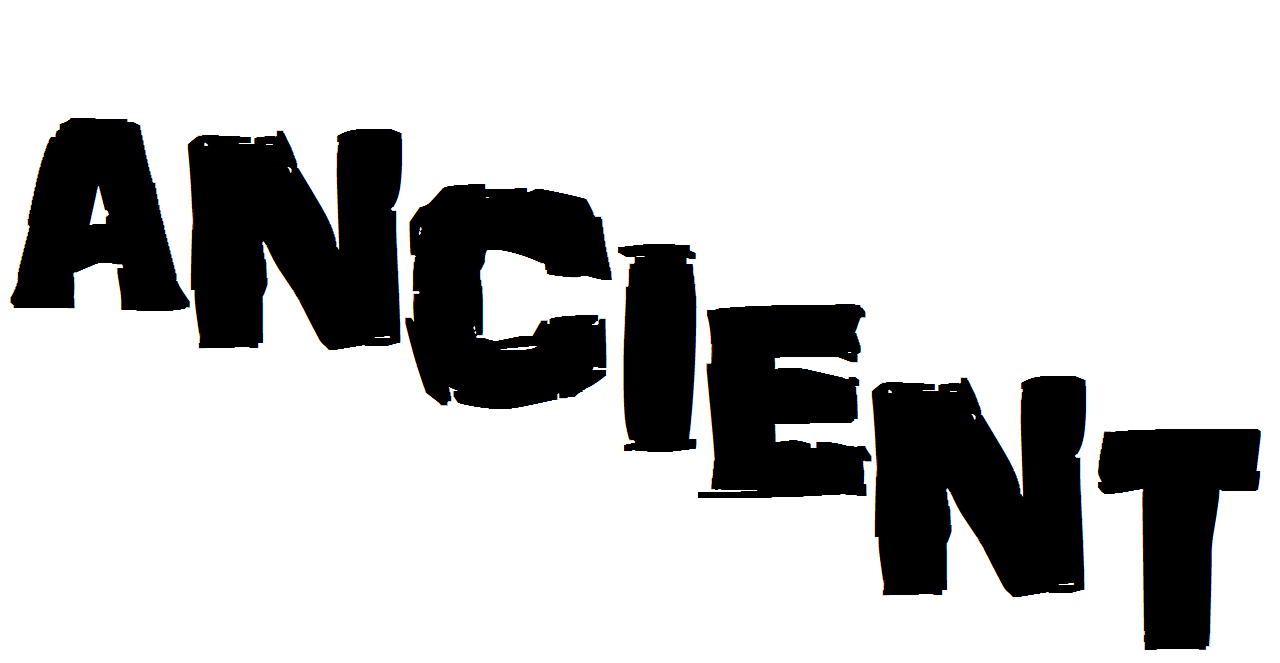
The Word assignment‘s image caught my eye as a visual depiction of “magic”.  The individual letters told a story in addition to the overarching word itself.  The assignment essentially gets the creator to start exploring the visuals that are evoked when we think of certain words.  For my creation, I attempted to visually depict the word “Ancient”.  I picked a font in Paint that had some distortion and areas that were deliberately incompletely filled (AR Darling).  This would ideally evoke older texts and aging materials.  I then started typing the word as I would in a normal word processor, and then began to “sink” the latter letters.  My hope was to create an effect where it looks like as the letters progress, the word begins to sag under the weight of time.

ancient

An Autobiographical Explanation of UvaSEP

I liked that this assignment was essentially about determining which characteristics define you.  So I ultimately went with describing a major aspect of my identity: my digital identity.  I chose to use my avatar as my cover background (this has been my standard avatar for around 4-5 years now).  I chose the title because my YouTube handle is UvaSEP.  This is a very odd username that was automatically derived from my first email.  This email was created for me at UVA’s Summer Enrichment Program.  It is completely arbitrary.  Yet my YouTube channel has almost 100,000 views, and this is the name my viewers know me by.  It’s a curious phenomenon, and one that I have simply procrastinated addressing.  As such, I figured its an odd enough situation to make an intriguing title that may potentially draw hypothetical readers in, while also referencing an important part of my life (namely video-editing).  The final product is below.

autobiography

Week 4 Summary

This week really emphasized the important role that sound has in contributing to storytelling.  A lot of this week’s assignments were practical, either encouraging us to engage with and discuss media or directly interact with it.  We were also exposed to ds106 radio, which was a fun resource that I wasn’t particularly familiar with before this week.  Live-tweeting was also a great way to engage with the larger ds106 community.  Getting exposure to the types of shows that are broadcast also helped me with the development of radio show ideas for the upcoming project.  I also really enjoyed getting to create a radio bumper for the station, which was a fun way to practically mess around with narration and music in a quick mix.  All of my thoughts on this week’s resources can be seen in my audio reflection post.

The assignments really encouraged us to mess around with pieces of sound in order to understand how its structure contributes to a certain atmosphere/tone.  This was especially apparent in the dramatic reading assignment (which essentially focused on how emphasis and tone can change the meaning of a piece) and the slow-mo song assignment.  This last assignment in particular was somewhat challenging, mostly from simply attempting to gather the media to edit in the first place.  MPEG streamclip wasn’t working, so I eventually had to resort to a direct download from YouTube.  Luckily I’m somewhat familiar with Audacity, which made the majority of this week’s work much easier.  The Familiar Sounds assignment also reinforced the importance of maintaining a sense skepticism when evaluating any sort of information, while also allowing us to see how a story can be constructed from ordinary objects.  Finally, the must-do Sound Effects assignment was a fun way to gain exposure to freesound.org as a means of finding sound effects.  It also reiterated the basics of storytelling while also providing us with an opportunity to practice sound layering with multiple tracks in Audacity.

The daily creates were fun this week, even including some interactions with other daily creates.  I think I especially liked creating an explanation for the phone app icon (as honestly phones look nothing like that image anymore).


Overall this week was a fun way to directly engage and alter media to get a better understanding of audio structure and the properties that come with changing it, while also allowing us to build some practical skills with software such as Audacity.

Werewolf Sound Effects

One of the must-do assignments was to create a story using only sound effects.  It took some pondering to figure out what I wanted to do.  I ultimately decided to create a werewolf attack.  You see, every Saturday my friends and I play a role-playing game called Werewolf (similar to Mafia or Town of Salem), whereby each of us is a citizen in a village that has a werewolf infestation.  This was essentially my inspiration.  So I went to freesound.org to search for suitable sounds.  I included wolf howling, some dark ambiance, heavy breathing, running through grass, door slamming, banging, a crash, dogs growling, and heartbeat sound effects.  One of the growling dog pieces I used was actually a dog hyperventilating, which created this really throaty effect that fit the piece well.  Honestly the hardest part was arranging all of the sound snippets in Audacity to create the atmosphere I wanted.  It was essentially a lot of tinkering.  The final product is below.

The story I was trying to convey is a man running from werewolves.  He reaches his home and bars the door, only to have the werewolves tear through and (presumably) attack him.  It concludes with the sound of a heartbeat that eventually ends…

Constructing Construction

I like how everyday sounds, when taken out of context, can turn into something completely different.  This led me to try the Familiar Sounds assignment.  I began by recording my bathroom fan in Audacity.  The sound itself is very rhythmic, and has a somewhat industrial feel to it.  This led me to the second half of the assignment: creating a story.  I decided to compliment this industrial sound with other construction noises.  Using the free sound effects library in YouTube, I found sounds for hammering, starting a baler, and air nailing.  By combining these in new tracks within Audacity, it created a plausible construction scene.  This reminded me somewhat of the Foley video, in that familiar items can be used to create the sound effects for an unusual scene.  I’ve mentioned this theme before, but I feel that it’s worth mentioning how this also strengthens the idea of maintaining a somewhat skeptical mind.  First impressions (in radio, the Internet, and other mediums) can be deceiving, especially with the editing technology we have at our disposal now.

Slow-Mo in 1812

I liked the idea of playing around with recognizable songs, altering their structure to create a totally new tone or atmosphere.  Sometimes the best way to understand a concept or medium is to simply work with it.  So I decided to try my hand at the Make it 800% Slower assignment.  I will say that the process was much more difficult than I anticipated.  I had previously used MPEG Streamclip to capture songs from YouTube videos, and originally thought I’d try to grab Mind Heist.  However, it appears that something has changed over the last few years… as almost all the files I tried to open were the “wrong file type”.  Google searching solutions yielded nothing.  I almost decided to give up the assignment completely, until I remembered that YouTube has a free video library where you can download MP3 files.  I then found a free copy of the very dramatic 1812 overture.  Perfect.  Mellowing this classic dramatic piece was definitely a fun exercise.  However, my first attempts at slowing the piece down were not particularly successful.  I attempted to slow it down (with an effect that altered audio speed) by 99%, but this merely resulted in Audacity crashing twice.  I then decided to simply slow it down 50%, and then adjust it again to 75%.  I attempted to play around with the pitch some, but I’m not sure I was entirely successful in creating a normal-sounding song.  However, the result is a somewhat eerie techno-sounding piece that is almost unrecognizable from the original (which was ultimately the goal).


ds106 Radio Bumper

This was a fun assignment that allowed us to try and creatively sell ds106 radio.  I actually began by creating the concluding fun tagline for the show, making my final decision by choosing a phrase that rhymed with “six”.  I then created the introduction with the station description, trying to keep the line short and sweet.  After writing out the two sections I recorded the statement on Audacity, keeping in mind the importance of trying to sound normal (rather than stretching to mimic some sort of fictitious “radio voice”).  Finally, I visited freesound.org to look for suitable background music, ultimately choosing a piece that was very close in length to my piece of verbal dialogue.  I then created a new stereo track and copied this music piece into Audacity to allow the piece to play concurrently with the dialogue.  I played around with the audio levels to make sure that the music did not drown out my narration.  Once I was satisfied, the final exported result was this lovely advertisement.